
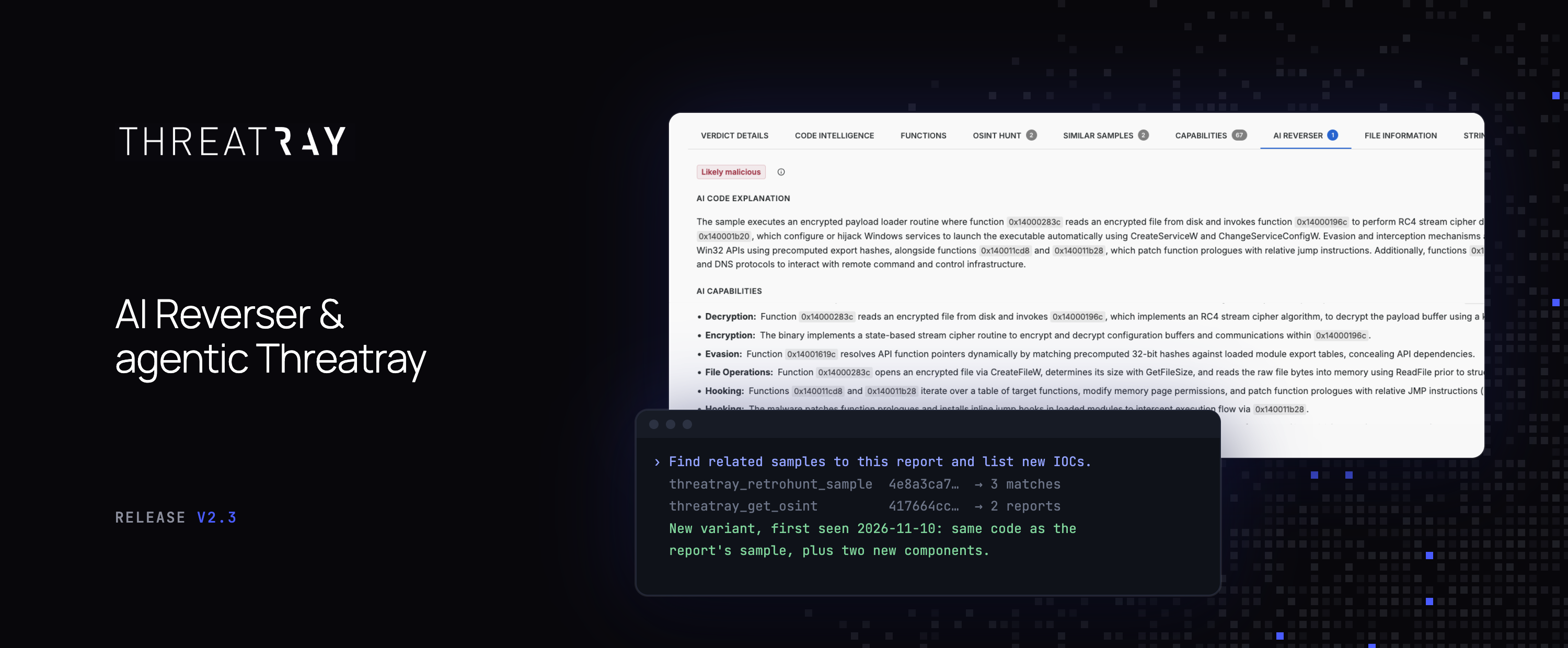
AI is changing how malware gets analyzed. Analysts use it to understand unfamiliar code, and AI agents take on more and more of the investigation. What AI lacks is context: which code is harmless, which belongs to known malware, and where it has been seen before. That context is what Threatray provides. Today we bring it to AI in two ways: as the AI Reverser in Threatray, and as the MCP server for your own agents.
The AI Reverser
Antivirus detections, YARA hits and family names are signals. A single antivirus detection tells you very little. A family name leads to threat reports, and the reports describe what the family can do. None of them tell you what the exact sample in front of you does. Finding that out has meant reverse engineering the code. That takes time, and many of the people who need the answer are not reverse engineers.
The AI Reverser decompiles the code in an analysis, from submitted files and from code extracted from process memory, and tells you three things about each code region and each function:
- AI code explanation: what the code does, for example "This code region downloads remote payloads over HTTP and executes them in memory."
- AI capabilities: what the code implements, such as keylogging, process injection or C2 communication.
- AI verdict: whether the code is likely malicious, suspicious or likely benign. Knowing what is benign is as valuable as knowing what is malicious.
You get two levels: a summary for quick triage and decisions, next to the other verdicts in the analysis, and in-depth results down to each function for analysts who want to dig deeper.

Where it helps
The AI Reverser supports the core malware use cases: triage, incident response, malware intelligence and reverse engineering.
Is this malicious? A sample with no detections, or only an unspecific antivirus or YARA hit, leaves you guessing. The AI Reverser gives you a verdict based on what the code does, with an explanation you can check.
What does this sample do? Families evolve, and threat reports often describe a different version from the one you have. Loaders and other helper components often never get a family name at all. The AI Reverser explains what the exact build in front of you does and lists its capabilities.
What can I safely ignore? Knowing what to ignore is half the job. A libcurl.dll sitting in a folder an attacker could write to looks exactly like a backdoored library. The AI Reverser finds nothing but genuine libcurl and calls it benign.
Where do I start reversing? The AI Reverser gives you a map of the binary: which functions are library code, what the remaining functions do and which of them are malicious. You see at a glance which functions are relevant and go straight to investigating them.
Why it's different
The AI Reverser gives you answers in minutes, in plain language, and precise enough to act on. That precision comes from what Threatray is built on: a database of over one billion functions, many of them labeled as malware-family code or as benign library code.
Real-world binaries are full of statically linked library and runtime code. Threatray recognizes it as benign and excludes it from the AI analysis, so the AI spends its effort on the code that matters. In our tests, the AI Reverser found the handful of implanted functions in legitimate-looking DLLs with over 10,000 functions, in minutes (read the full analysis). An AI reading every function would take far longer, and could easily miss them.
Threatray examines every piece of unknown code in an analysis, including payloads that are unpacked or injected at runtime and never exist as a file on disk. The AI Reverser works on all of it.
Verifiability is a core principle of Threatray. Every statement in an AI code explanation and every AI capability references the addresses of the functions it is based on, so you can open the decompiled code in Threatray or in your disassembler and check it yourself.
The MCP server: Threatray inside your agent
AI agents are taking on more of the day-to-day work of malware analysis: triaging samples, hunting for related ones and reversing them. They are only as good as the data, intelligence and analysis capabilities they can draw on. Our MCP server lets your agent work with the whole Threatray platform: over 100 million analyzed samples and over one billion labeled functions, together with code-based retrohunting and clustering, the AI Reverser, full behavioral analysis and much more.
With that, your agent works from evidence, from what the code shows and what the sample did, with no guessing. Every sample triaged, every lead followed, every function explained: where time forces an analyst to stop after a few pivots, the agent keeps going and delivers results in minutes. Analysts who don't reverse every day can go deeper than they could on their own.
What your agent can do
Triage unknown samples. Give your agent the samples you don't recognize. For each one it runs the sample in Threatray's sandbox, identifies the family from code similarity, collects behaviors and IOCs, adds the AI Reverser's first reading of the code and checks for related samples and public reporting. Your time goes into judging the results, not collecting them.
Hunt and pivot. Start from the samples and IOCs in a threat report. Your agent retrohunts the samples across Threatray to find others built from the same code, follows the IOCs and behaviors, and groups the results into clusters. For each cluster you get the samples, how closely they are related, which ones are new variants and what new IOCs they bring, with the AI Reverser explaining what each variant does. Manual pivoting of this kind takes hours; the agent returns a structured result for you to review.
Reverse in depth. Your agent doesn't start from a blank binary. Threatray has already identified the library code, and the AI Reverser has mapped what the remaining functions do. From there, the agent reads the decompiled code, diffs functions between variants and checks which other samples share its key functions. It explains how the samples work, down to the individual function.
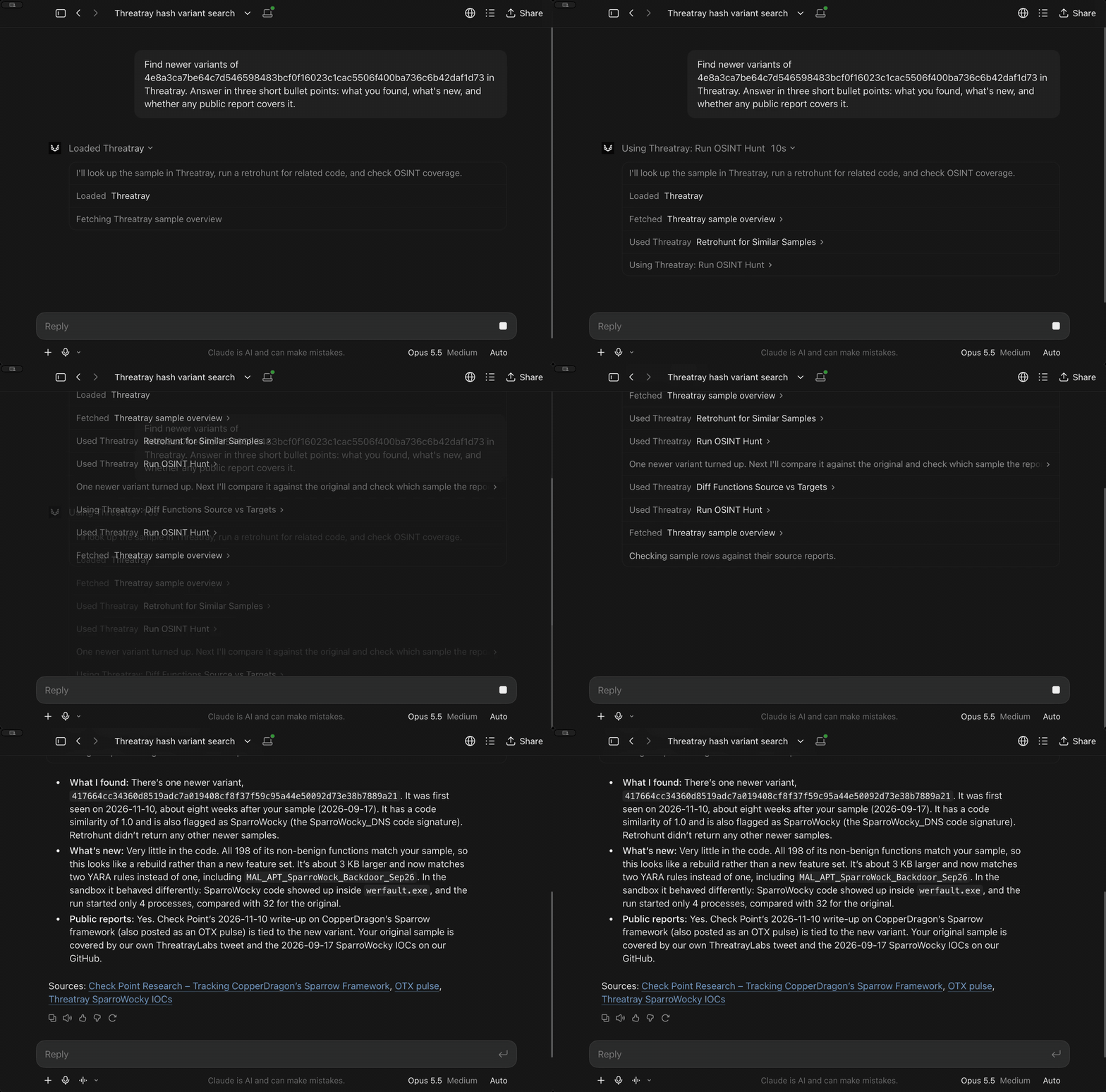
The Threatray MCP server works with any agent that supports the Model Context Protocol, including Claude Code, Codex and Cursor.
Available now
Both features are available now.
The AI Reverser is in every Threatray analysis. See the AI Reverser documentation.
The MCP server is hosted by Threatray, so there is no server to install or run: connect your agent, sign in and start working. See the MCP server documentation.
New to Threatray? Request a demo


